
Analysis: Big Tech May Be Getting AI Wrong
And the Signals Could Reshape Society Itself

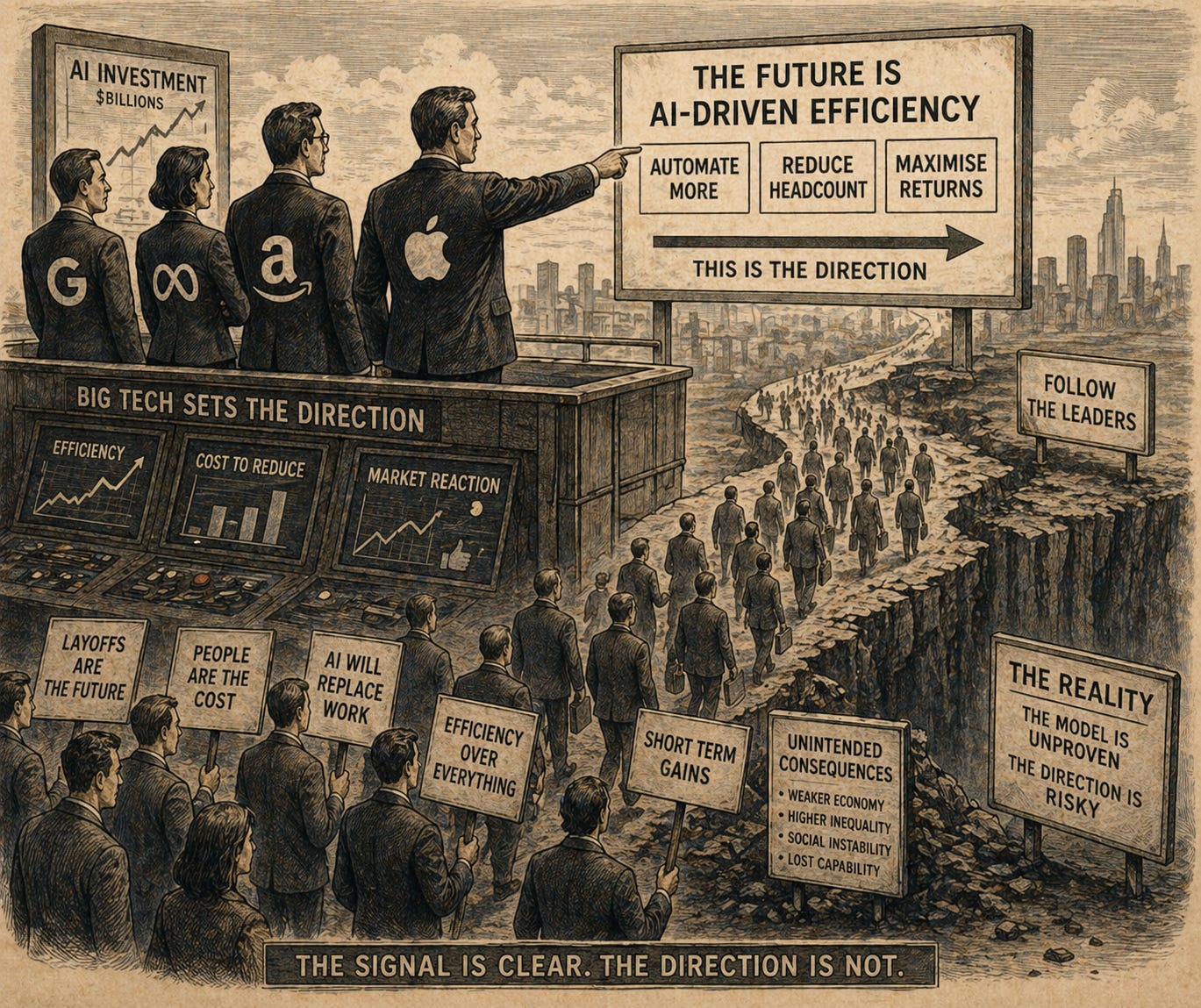
The creators of AI are sending those signals not just about the direction of technology, but about the future of work itself.
But that interpretation may be too early and more importantly, misdirected.
The risk is not in what Big Tech is doing…it is in how others interpret it.
Big Tech Has Always Set the Benchmark
For the past two decades, businesses have looked to Big Tech as a guide for how to adopt and scale new technologies.
From cloud computing to data infrastructure, the signals were not just influential, they were proven. What began at the frontier quickly became the standard across industries.
That dynamic has shaped how organisations think about transformation.
When Big Tech moves, others tend to follow…that pattern is now playing out again with AI.
When the Signal May No Longer Translate
This time, however, the signal is more complex.
Recent announcements across Big Tech point to a striking contradiction. Tens of thousands of roles are being cut, even as the same companies commit hundreds of billions of dollars to building out AI infrastructure.
In some cases, these reductions are being executed at scale and with limited human interaction, communicated through internal systems rather than direct engagement.
The pattern is consistent across the industry: large-scale investment in AI capability, paired with rapid reductions in workforce.
The trade-off is becoming increasingly visible capital is being redirected from people to systems.
For many, this is being interpreted as a clear direction of travel. AI increases efficiency, reduces the need for people, and reshapes how work is done.
What appears to be a clear signal of the future may, in reality, be a convergence of overlapping dynamics.
The risk is that this being lost and the signal is taken as a model .
A Model That Doesn’t Yet Exist
Following this thinking opens up a paradox, despite the pace of AI adoption, there is still no widely proven operating model for how AI and humans work together at scale.
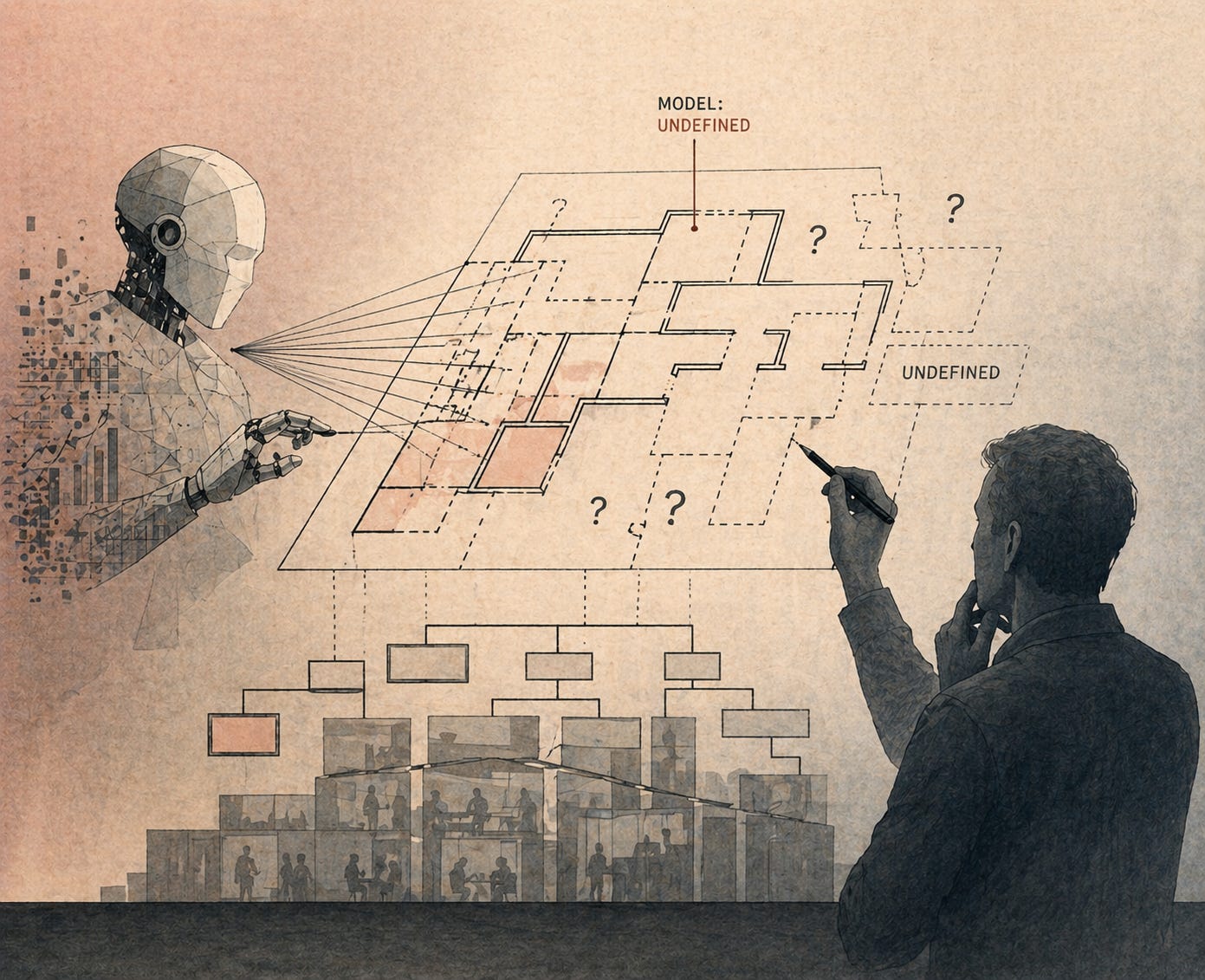
AI systems can generate outputs, identify patterns, and accelerate tasks. But they still require human input, direction, and interpretation to create meaningful outcomes.
Most organisations are not redesigning how work is structured around these capabilities. They are introducing AI into existing models that were never built for it.
The assumption that AI can replace people overlooks the role people play in making these systems effective.
We are making structural decisions based on a model that does not yet exist.
The model is not yet defined, yet the creators of AI are already setting a direction with significant implications.
Mixed Signals in the Market
The impact is already visible in how markets are responding.
Hiring is slowing in certain areas, particularly in roles exposed to automation, while demand for specialised AI talent continues to rise. Recruitment patterns are beginning to diverge, with fewer entry-level and generalist roles, and greater concentration in highly technical positions.
At the same time, employee confidence across the tech sector has weakened, and voluntary movement in the labour market has slowed. Fewer people are leaving roles, reflecting a more cautious and uncertain environment.
Financial markets are also beginning to interpret these signals. Companies demonstrating AI-driven efficiency are being rewarded, while those with higher cost bases face increasing pressure to restructure.
Taken together, these shifts are reinforcing a particular narrative: that efficiency gains will come through reducing headcount.
In responding to them, the market may be amplifying a trend before the underlying model has been proven.
Efficiency Gains, Capability Loss
What is often overlooked is not just that businesses operate within systems, but that they rely on capabilities that are not always visible on a balance sheet.
In the near term, the shift is attractive. Reducing headcount while increasing efficiency improves margins, strengthens financial performance, and is often rewarded by the market.
For Big Tech, this is not just a strategic choice, it is a financial and structural one. The scale of AI investment, combined with market expectations, is driving a sharper focus on efficiency.
In that context, reducing workforce costs becomes one of the most immediate and controllable levers.
But what is being removed is not just cost. It is capability.
Experience, context, internal knowledge, and the ability to interpret and act on information are often embedded within people. When that layer is reduced, the organisation may become more efficient on paper but less capable in practice.
And within any business, that capability is not easily rebuilt.
The very skills required to improve, guide, and fully leverage AI systems are often the ones being reduced.
At the same time, demand for that capability is becoming more concentrated across the same small group of companies.
This creates a tightening market, where the pool of experienced talent becomes harder to access, not easier.
By the time the gap becomes visible, rebuilding it may be slower, more expensive, and more complex than anticipated, even for those setting the direction.
The Hidden Economic Feedback Loop
The impact does not stop at the organisation.
Every organisation, even Big Tech, sits within a broader economic structure, where employment, consumption, and taxation are closely linked.
In the near term, reducing headcount can improve efficiency and strengthen financial performance.
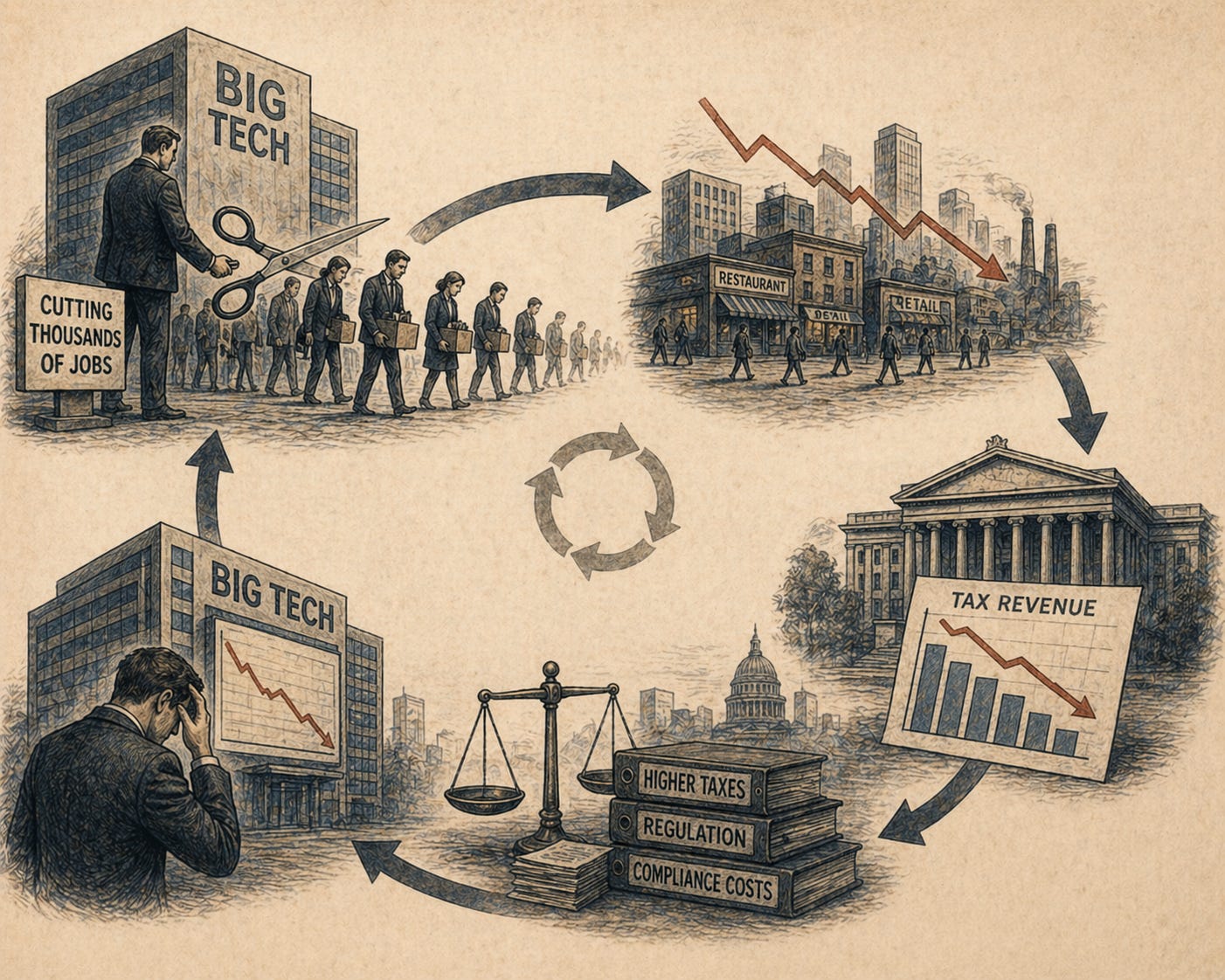
But fewer people earning income means less spending across the economy. That reduction in demand affects other businesses, slows growth, and begins to reshape the conditions companies depend on.
Fewer people earning income means less spending, less spending slows growth.
and slower growth reshapes the conditions businesses depend on.
At the same time, governments face a different kind of pressure.
As national debt levels rise, public finances become increasingly sensitive to changes in tax revenue. A smaller workforce, combined with shifting income patterns, can reduce the tax base that supports those systems.
That can take many forms: changes in taxation, increased regulation, or shifts in policy designed to stabilise the system.
What begins as a firm-level decision to improve efficiency can, over time, contribute to broader economic adjustments.
And those adjustments often find their way back to the businesses that initiated the change.
Setting a dangerous precedent
What is often missed is this human element in all of this and too many is not only a cost structure.
It is how people generate income, contribute to society, and find direction and meaning in their lives.
The way these systems are designed will determine not just how businesses operate, but how people participate in the economy itself.
That places a level of responsibility on those setting the direction.
Not to avoid efficiency, but to ensure that the systems being built are sustainable, inclusive, and capable of supporting both economic growth and human participation.
The Implication
Whether we acknowledge it or not, the responsibility for shaping the future of society is shifting.
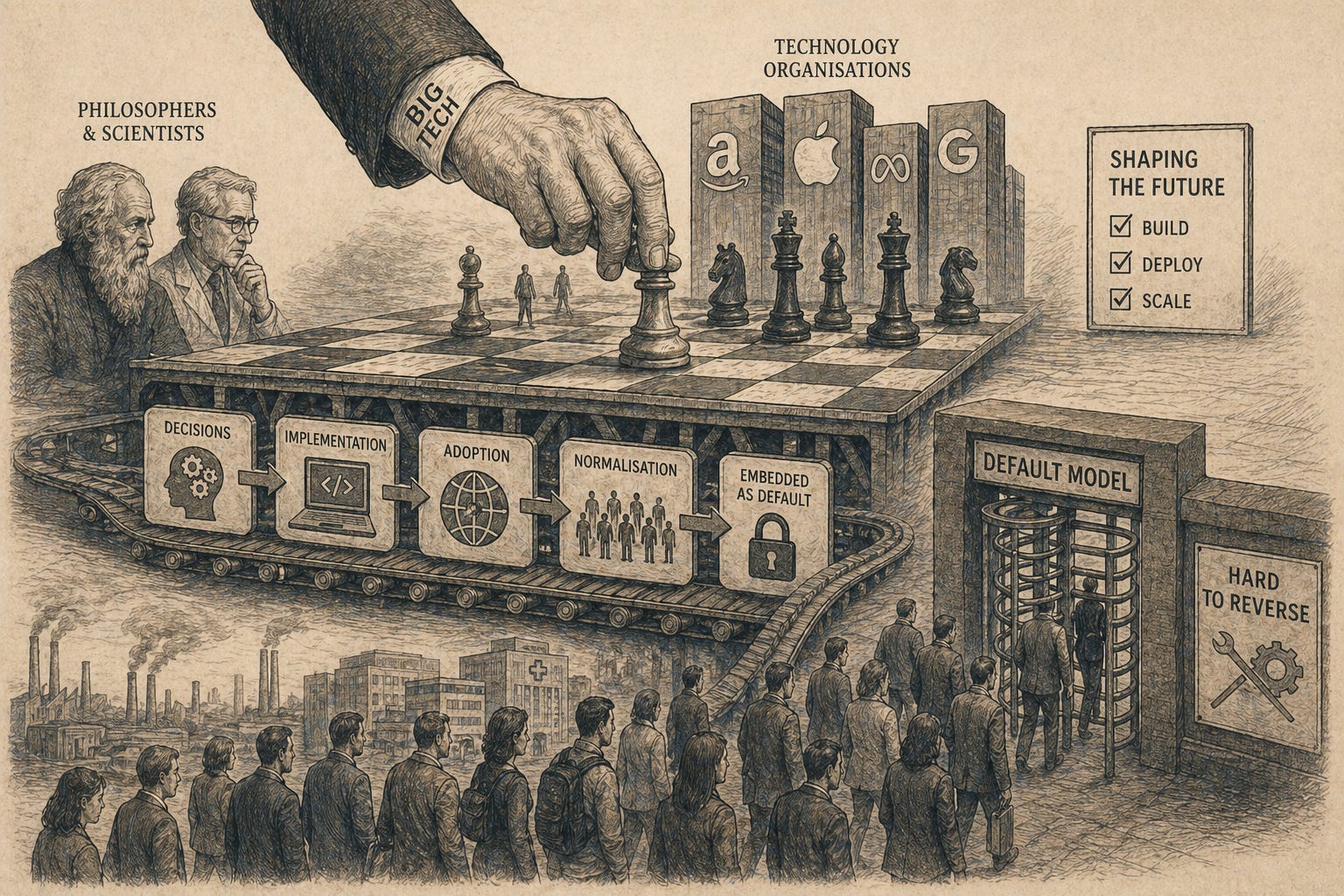
It is no longer driven primarily by philosophers and scientists. It is increasingly being defined by the organisations building and deploying technology.
The risk is not that these organisations are making the wrong decisions.
It is that their decisions become the default model, replicated at scale, before the implications are fully understood.
And once that model is embedded, it becomes difficult to reverse.
What Needs to Change
The response to this moment is not to slow down the development of AI.
Nor is it to resist the efficiency it can create.
But it does require a shift in how we understand responsibility.
The organisations building AI are influencing labour markets, economic structures, and the broader direction of society.
That level of influence requires a different kind of coordination.
Closer alignment between AI builders, policymakers, and institutions will become increasingly important, not to restrict innovation, but to ensure that its effects are understood and managed as they scale.
At the same time, there needs to be greater awareness of how signals are formed and interpreted.
Decisions made at the frontier are no longer contained within those organisations.
They are observed, replicated, and embedded across the market.
That places a responsibility on those setting the direction.
Not just to optimise for efficiency, but to recognise the scale of the impact their decisions carry.
At Scale, Accountability Changes
It also requires a higher level of transparency.
Workforce reductions at this scale are not marginal adjustments.
They have a direct and immediate impact on labour markets, local economies, and broader economic conditions.
When tens of thousands of roles are removed, the effects extend far beyond the organisation itself.
At that level, there is a growing expectation that these decisions are clearly articulated.
Not just in terms of cost efficiency, but in terms of what they signal, what they enable, and how the resulting impacts are being managed.
That includes explaining how capability will be rebuilt, and what pathways are being created for those displaced.
Reskilling, redeployment, and transition into new roles are not secondary considerations. They are central to whether this shift strengthens or destabilises the system.
Without that, the risk is not just displacement, but systemic strain.
Closing Thoughts
Big Tech has long set the blueprint for how we work and live.
Now, for the first time, that blueprint may be leading us in the wrong direction.
Not because the technology is flawed, but because the model is not yet understood.
What is adopted today will shape the society of tomorrow.
And by the time we question it, it may already be too late to redesign it.