
Analysis: Cost Reduction Is Not a Strategy
The Hidden Cost of Efficiency

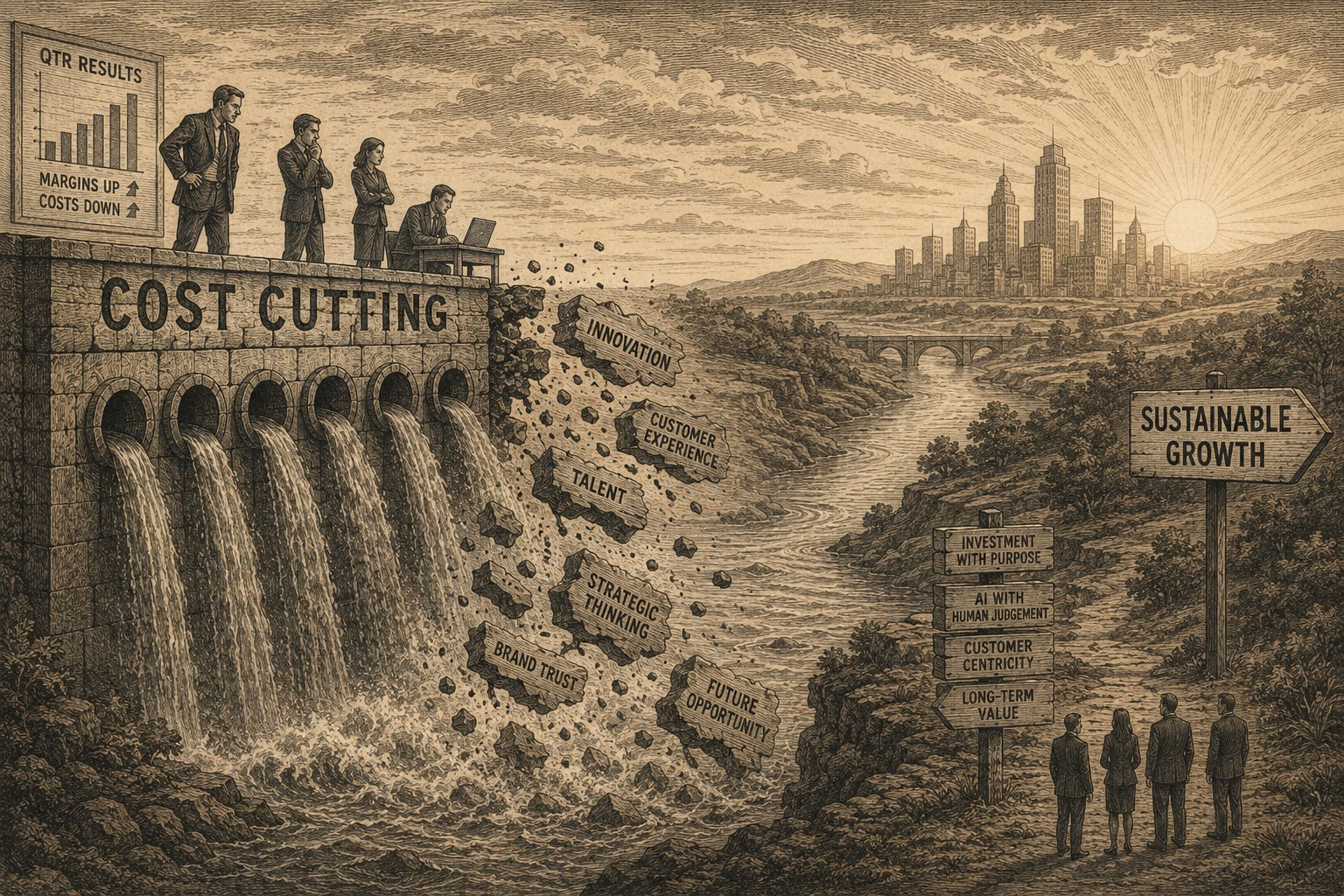
Across my career, I’ve seen organisations save millions through operational improvements, automation, and simplification. Financial discipline matters. Efficiency matters. Strong businesses should absolutely know how to scale effectively.
But I’ve also seen something else happen.
Some organisations become so focused on improving the balance sheet that they slowly begin weakening the very things that made them valuable in the first place.
Innovation slows, customer experience deteriorates, strategic thinking becomes shorter-term, and over time, the business starts optimising for efficiency rather than future relevance.
And I think AI is now accelerating that risk. The real question is, why do organisations continue to think this way?
The Fastest Way to Improve Margins
The quickest way to improve margins and reassure shareholders is usually to reduce costs. The impact appears quickly, it is measurable, and it creates the appearance of operational discipline. Leadership teams can point to leaner operations, stronger margins, and improved efficiency metrics, while markets often respond positively to visible short-term financial improvements.
The problem is that balance sheets rarely capture what is quietly being lost in the process.
What often disappears alongside those reductions is future opportunity. Innovation slows, customer experience weakens, adaptability declines, and institutional knowledge begins to erode. Unlike cost savings, however, these consequences rarely appear immediately. They appear slowly over time, often becoming visible only once a business begins losing relevance, differentiation, or customer trust.
The Balance Sheet Mindset
Part of the problem is that many organisations are still managed primarily through a balance sheet mindset.
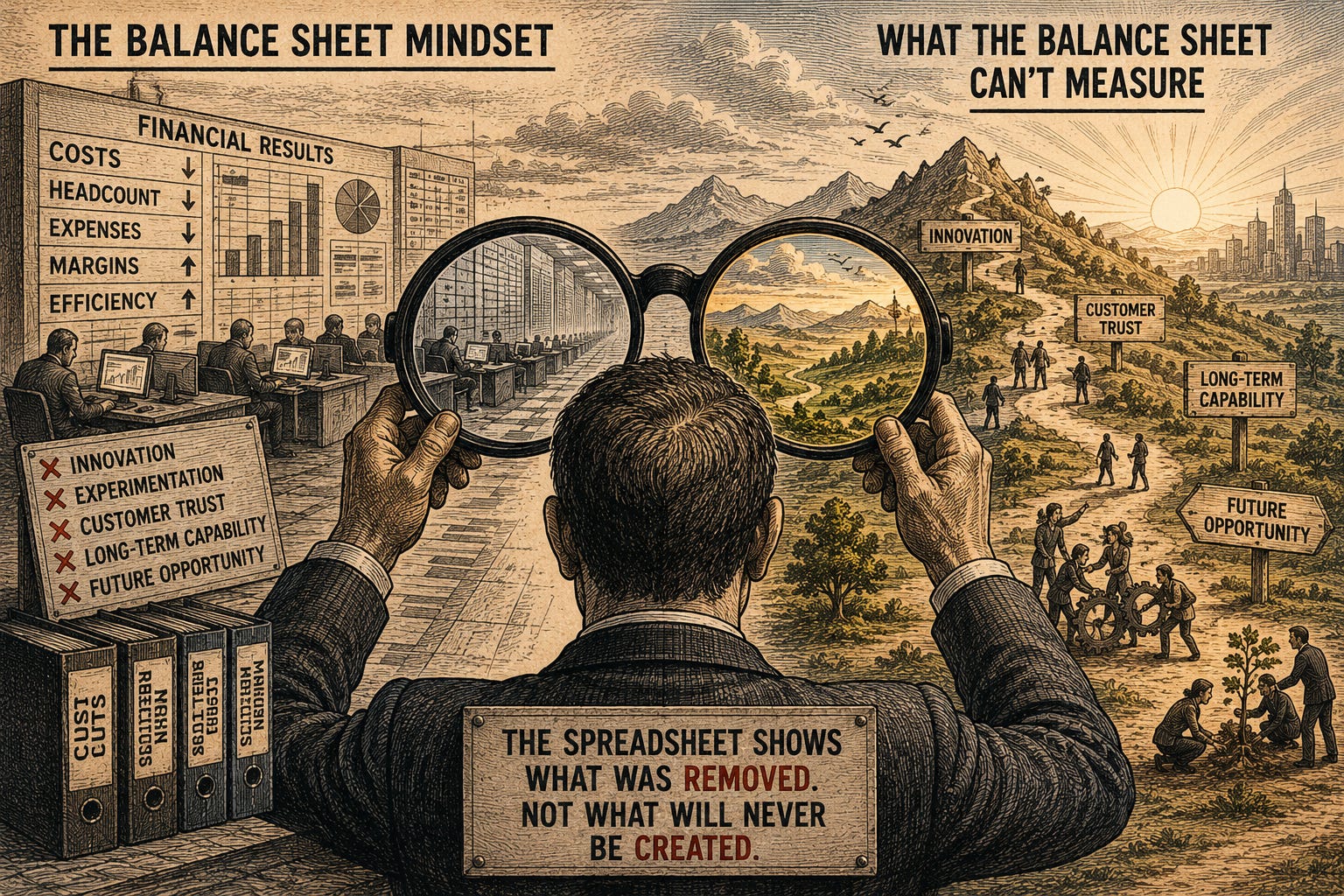
Finance functions are designed to improve efficiency, protect margins, and reduce costs, and those disciplines absolutely matter.
But balance sheets are far better at measuring short-term financial improvement than they are at measuring lost opportunity, weakened innovation, declining customer trust, or the erosion of long-term capability.
You can often see this reflected in leadership teams too. When organisations are heavily led through a finance lens, particularly when CEOs come from strong finance or FD backgrounds, strategy can gradually become dominated by efficiency, risk reduction, and short-term optimisation.
Over time, experimentation slows, innovation becomes harder to justify, and businesses start managing for operational performance rather than future market leadership.
Strategy Determines the Right Costs
One of the biggest mistakes organisations make is treating cost reduction as the strategy itself, rather than ensuring costs are aligned to the strategy they are trying to achieve.
Costs should reflect positioning. A premium business should invest in premium experiences, premium service, premium talent, and product quality. An innovation-led company should expect experimentation, research, and long-term capability building to be part of its operating model. A customer-centric organisation should invest in relationships, trust, and support.
When businesses aggressively reduce the very capabilities that support their strategic position, they create internal contradictions.
You cannot claim to compete on trust while underinvesting in customer experience. You cannot position yourself as innovative while cutting experimentation and long-term capability building. Eventually, the strategy and the reality no longer align, and customers begin to notice the gap.
The Hidden Cost of Efficiency
The danger is that, over time, organisations can become so focused on operational efficiency that they unintentionally weaken the very areas that create long-term competitive advantage.
I’ve seen organisations focus so heavily on cost reduction that they unintentionally damage the very areas that create long-term value.
I’ve seen product quality reduced while businesses claimed premium positioning. I’ve seen customer support cut while organisations spoke publicly about loyalty and trust. I’ve also seen companies remove experienced people in pursuit of automation, only to later realise that judgement, context, and human understanding are significantly harder to replace than expected.
At the same time, I’ve also seen organisations achieve both growth and efficiency together. The strongest businesses are not choosing between cost management and revenue growth.
They are redesigning the business, simplifying complexity, improving customer journeys, enabling better decision-making, and using AI to enhance capability rather than simply remove labour.
That is a very different approach.
AI Is Accelerating This Tension
AI is now amplifying this divide inside many organisations. Despite the excitement surrounding innovation and transformation, many executive conversations still begin with the same underlying question, how much cost can we remove?
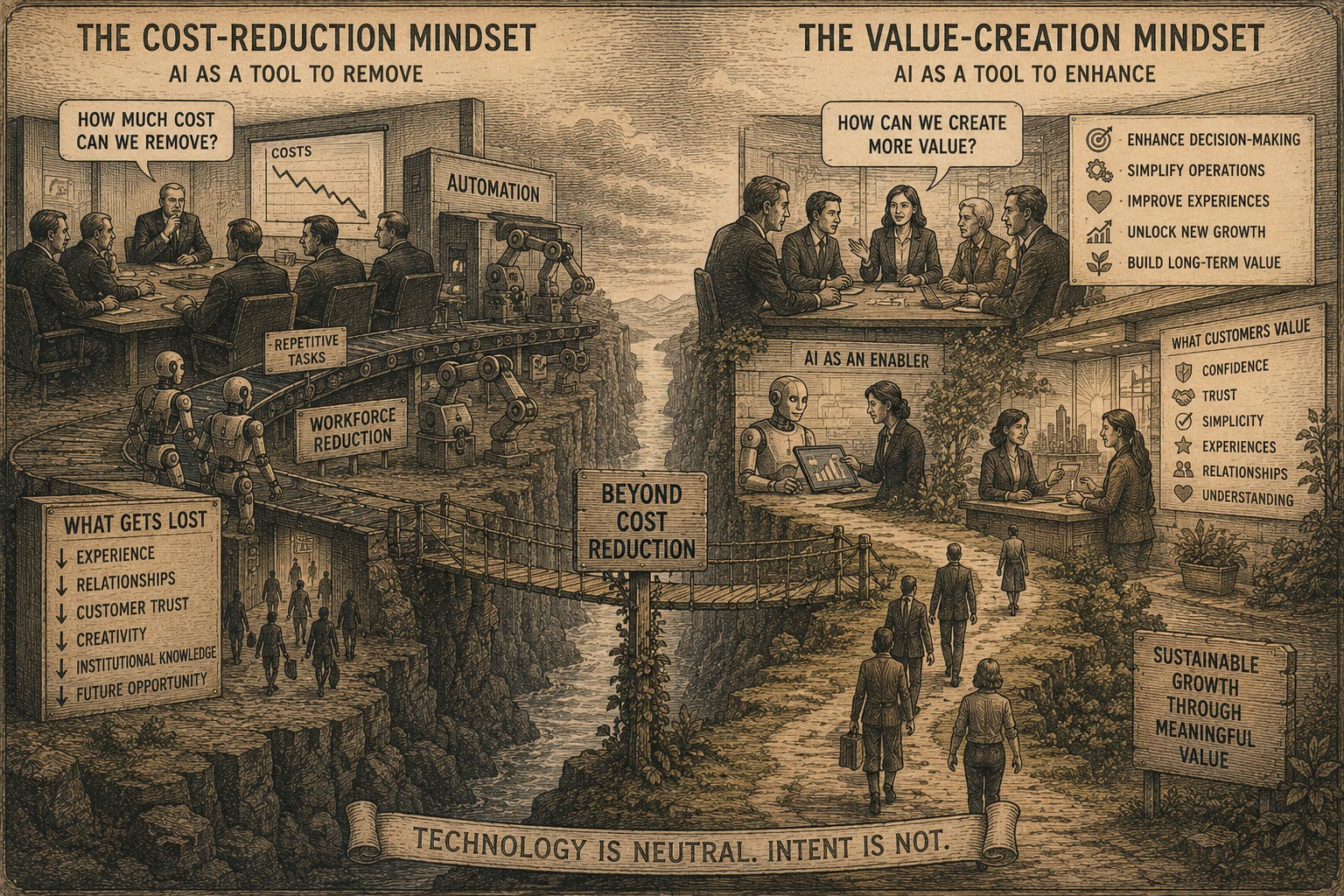
There is nothing wrong with efficiency itself. Businesses should evolve, operations should improve, and repetitive processes should absolutely be simplified where possible. However, reducing headcount is not the same as transformation, and automation alone is not innovation.
Some organisations risk becoming so focused on reducing labour that they forget what customers actually value in the first place. Most people do not simply buy products or services. They buy confidence, trust, simplicity, experiences, relationships, and understanding. These things are significantly harder to automate, particularly in industries where differentiation increasingly comes from experience rather than access alone.
This is why the conversation around AI needs to mature beyond cost reduction.
What Businesses Need To Do
The organisations that thrive will not be the ones that simply remove the most cost. They will be the ones that understand how to balance efficiency with growth, automation with human capability, and operational discipline with long-term value creation.
That requires businesses to think differently about transformation itself. AI should not simply be deployed to reduce labour costs. It should be used to improve decision-making, simplify operations, remove friction, enhance customer experience, and unlock new revenue opportunities.
The goal is not just to become leaner, but to become smarter, faster, and more adaptable while continuing to deliver meaningful value to customers.
Intelligence With a Human Touch
The strongest organisations will also understand that competitive advantage increasingly comes from overdelivering on experience, trust, and outcomes. In a world where technology becomes more accessible to everyone, the differentiator may no longer be access to AI itself, but how effectively businesses deliver intelligence with a human touch.
The companies that win will be those that use AI to enhance human capability rather than replace it entirely, creating organisations that are both operationally intelligent and deeply customer-centric.
Final Thought
Over the next decade, most businesses will gain access to similar AI, similar tools, and similar automation.
The real differentiator may not be who reduces the most cost, but who creates the most value by delivering intelligence with a human touch.
Because businesses rarely fail the moment costs are cut.
They fail when, over time, they optimise away the very reasons customers chose them in the first place.