
Analysis: Product Management in the Age of AI
Accelerating Idea to Value

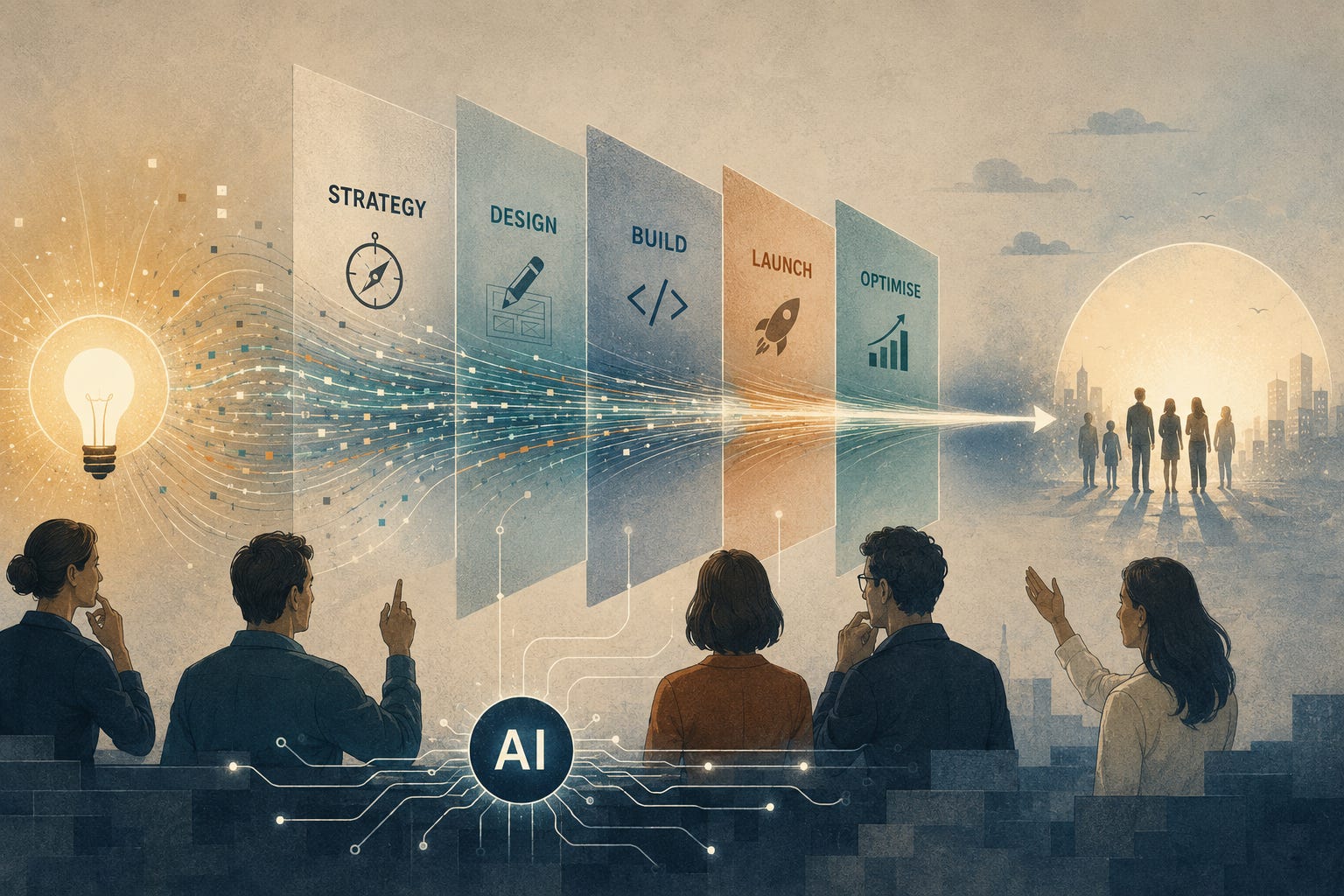
As a product leader, I have had the privilege of witnessing multiple evolutions in how digital products are created.
Organisations moved from long, sequential delivery models to Agile ways of working, bringing product, design, engineering and delivery teams together in cross-functional teams.
Yet despite all of these changes, one thing remained constant: People.
AI is now beginning to challenge those constraints.
For the first time, every stage of the product lifecycle is being compressed simultaneously.
Activities that once took weeks may increasingly take days. Activities that once took days may increasingly take hours. The implications extend far beyond productivity.
The Modern Product Factory
Most digital products today move through five interconnected phases: Strategy, Design, Build, Launch, and Optimisation.
While Agile transformed how these activities are delivered, the phases themselves remain largely unchanged. The biggest difference is that people now work in cross-functional teams, but their roles have remained broadly consistent.
Product leaders identify opportunities and define direction. Product managers, researchers, and designers validate customer problems and shape solutions. Product managers, designers and engineers work together to define, build and release products and features, with product teams providing prioritisation and direction.
The modern product factory may be significantly faster than it was twenty years ago, but it still relies heavily on human effort across every stage of the lifecycle.
That is now beginning to change.
Strategy at the Speed of Intelligence
Lets take strategy first, something that has traditionally been one of the slowest phases within the product lifecycle. Understanding customer needs, analysing competitors, evaluating opportunities, developing business cases and aligning stakeholders often requires weeks of research and discussion before decisions can be made.
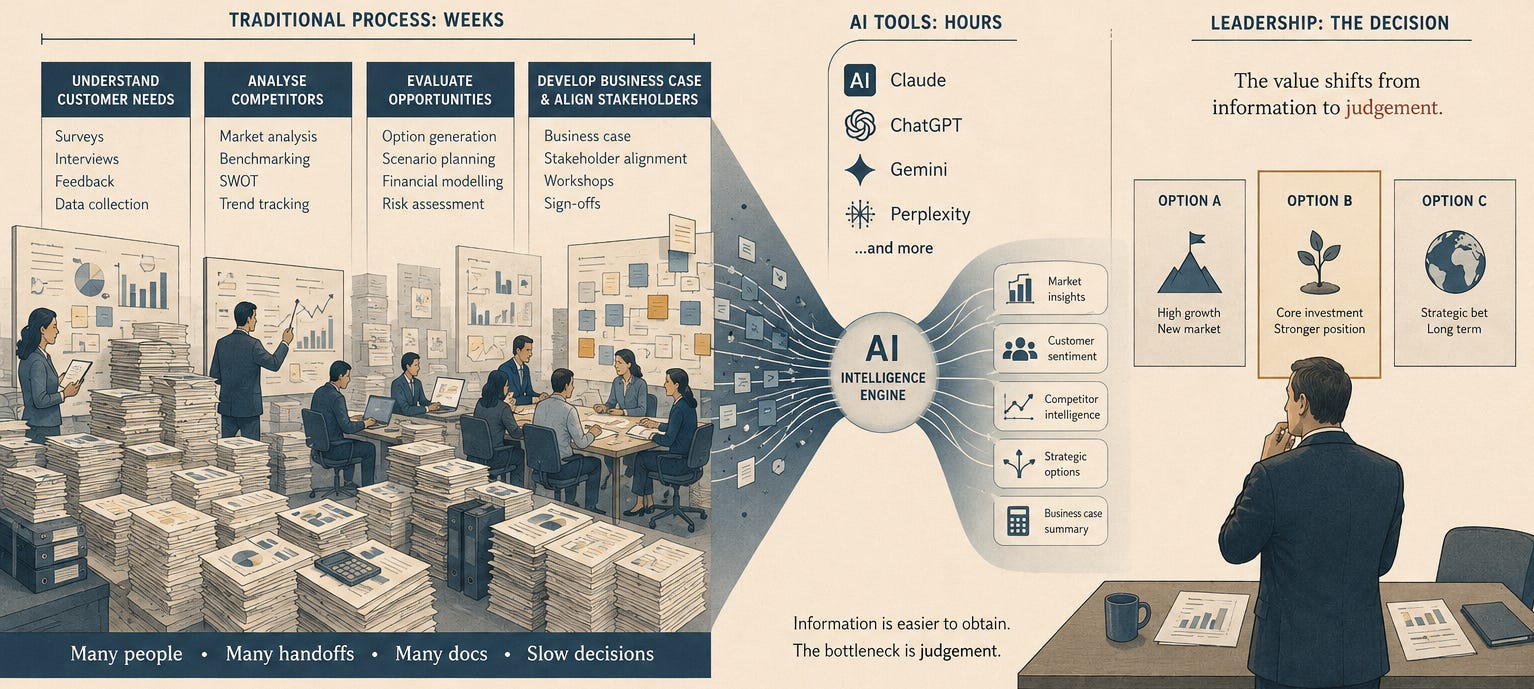
Today, tools such as Claude, ChatGPT, Gemini and Perplexity are dramatically reducing that effort. Market analysis, competitor research, customer feedback synthesis and strategic option generation can increasingly be completed in hours rather than weeks.
The most interesting shift is not the speed itself, but where value moves as a result. When information becomes easier to obtain, leadership becomes less about gathering insights and more about exercising judgement.
The bottleneck is no longer access to information. It is deciding which opportunities deserve investment.
Design Without the Waiting
Design has traditionally been where strategy becomes tangible. Customer needs are explored, propositions are shaped, experiences are designed and priorities are established. Product managers, researchers and designers often spend weeks conducting discovery, analysing customer feedback, creating journeys, defining requirements and refining solutions before development begins.
AI is dramatically reducing the time required to move from an idea to a validated concept. Tools such as Claude can synthesise customer research, generate product specifications and create user stories. Platforms such as Kiro can transform product concepts into structured requirements and delivery plans, while tools such as Figma AI, Lovable and Bolt can generate prototypes in hours rather than weeks.
Activities that once took weeks increasingly take days, allowing organisations to test, learn and iterate at a pace that was previously impossible.
Building at Machine Speed
Regardless of how strong the strategy or how compelling the customer problem, progress ultimately depended on engineering capacity. Product roadmaps were often shaped as much by available development resources as they were by customer demand.
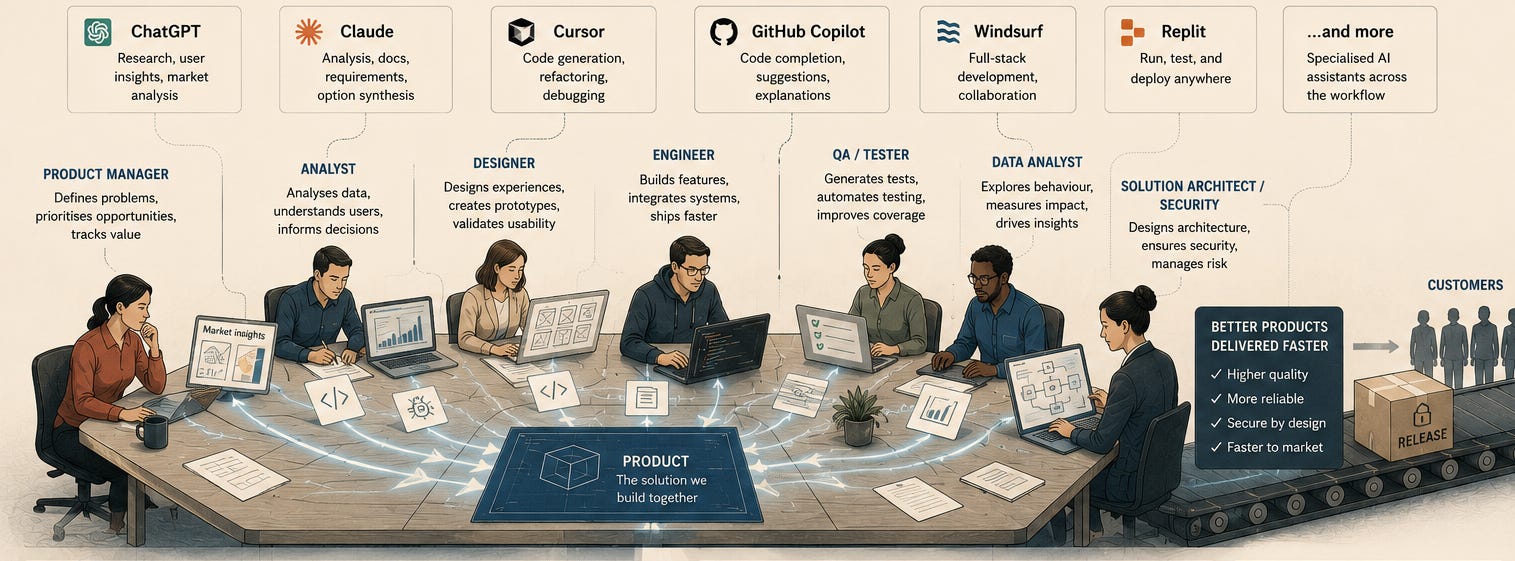
Today, tools such as Cursor, Claude Code, GitHub Copilot, Windsurf and Replit are beginning to change that equation.
Engineers can generate code, create documentation, automate testing and accelerate delivery at speeds that would have seemed unrealistic only a few years ago. Activities that once required weeks of development effort can increasingly be completed in days.
This does not remove the need for engineering expertise. Instead, it changes where that expertise is applied. As code generation becomes easier, engineering value shifts towards architecture, governance, security, quality and validation. The role evolves from creator to orchestrator.
Launching Without the Bottlenecks
Launching products has traditionally required significant coordination across product, marketing, sales and commercial teams.
Positioning must be developed. Campaigns must be created. Customer communications must be prepared. Sales teams must be enabled. While Agile accelerated product delivery, commercial readiness often remained a separate constraint.
Many organisations still spend weeks preparing products for market after development is complete.
AI is beginning to reduce those delays. Tools such as Claude, ChatGPT, Jasper, Canva AI and HubSpot AI can generate campaigns, messaging, content and customer communications at unprecedented speed.
As a result, products are becoming less constrained by execution and increasingly constrained by decision-making. The challenge is no longer whether organisations can launch quickly. It is whether they can make decisions quickly enough.
From Reporting to Prediction
Optimisation has traditionally been a reactive activity.
Teams launch products, gather data, review dashboards, analyse customer behaviour and identify opportunities for improvement. The process is often driven by historical information, meaning organisations spend much of their time understanding what has already happened.
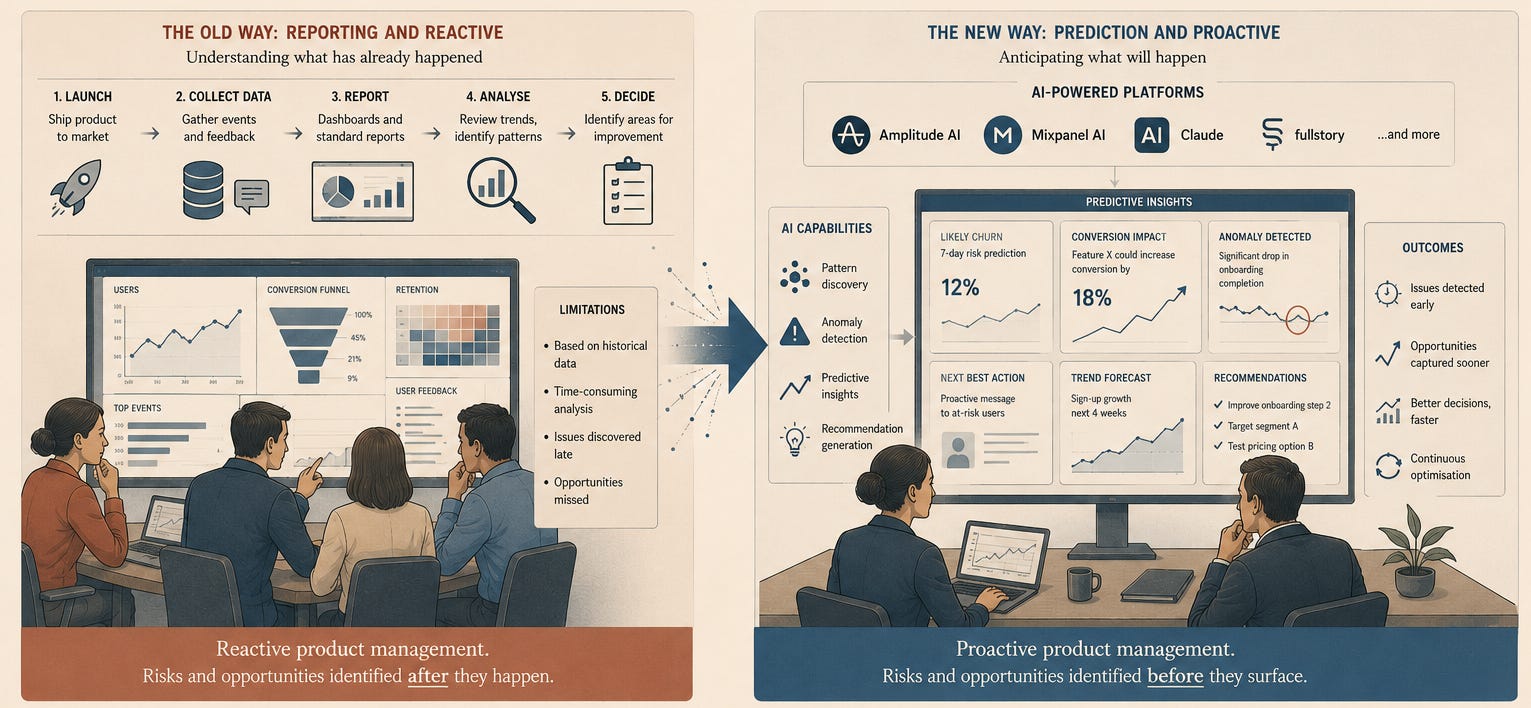
AI is beginning to move optimisation from reporting towards prediction.
Platforms such as Amplitude AI, Mixpanel AI, Claude and FullStory can identify patterns, surface anomalies and generate recommendations far faster than traditional analysis methods. Instead of simply understanding customer behaviour, organisations can increasingly anticipate it.
The result is a shift from reactive product management towards something ,more proactive product management, where risks and opportunities can be identified before they become visible through traditional reporting.
The Product Factory Is Compressing
What is clear is that unlike previous shifts, AI is not accelerating a single stage of the lifecycle. It is accelerating every stage simultaneously.
In software development, organisations are already reporting significant productivity gains from AI-assisted coding. Similar gains are now beginning to emerge across research, design, testing, content creation, analytics and optimisation. The significance is not any individual productivity improvement. It is that every stage of the lifecycle is accelerating at the same time.
The distance between identifying an opportunity and delivering customer value continues to shrink
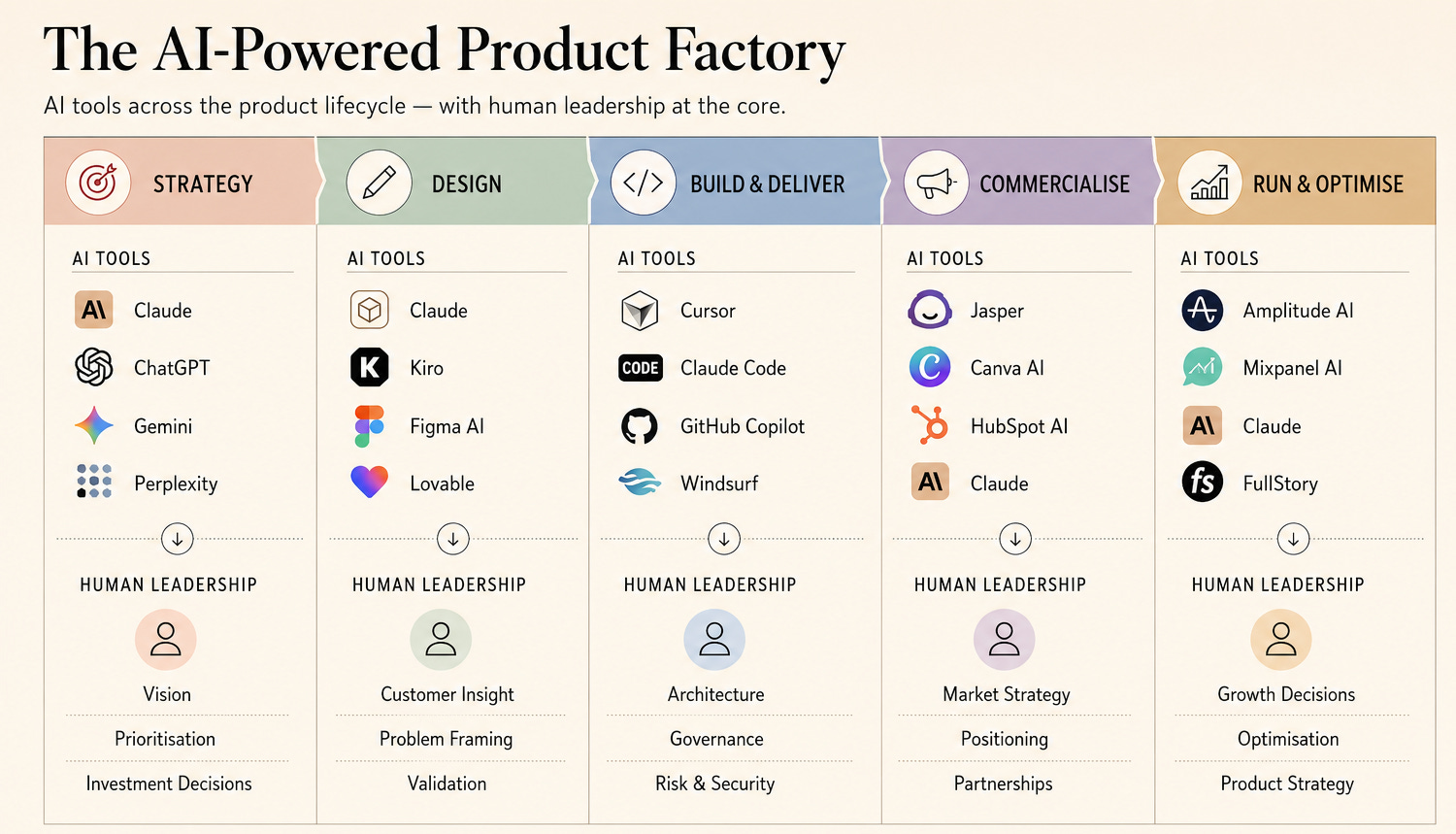
The tools will continue to evolve. The human role becomes increasingly consistent. As AI takes on more execution, people move towards judgement, validation, creativity, strategy and decision-making. The future product organisation may not be defined by how many people it employs, but by how effectively people and AI collaborate across the product lifecycle.
From Individual Capability to Organisational Capability
There is another shift happening beneath the surface.
Historically, capability sat inside people. Great product managers, designers, engineers and marketers accumulated knowledge through experience and shared it through conversations, documentation, coaching and collaboration. The effectiveness of a team was often directly linked to the experience of the individuals within it.
Tools such as Claude now allow organisations to create agents, skills and reusable workflows that can perform repeatable activities across the product lifecycle.
Rather than relying solely on individuals, organisations can begin building shared intelligence that improves the performance of every team. Capability starts to move from being something people possess to something the organisation itself can access and continuously improve.
What Businesses Need To Do
The more difficult question is whether existing operating models were designed for a world where intelligence moves this quickly. Governance structures, planning cycles, approval processes and organisational hierarchies were largely created around human constraints. As those constraints begin to change, many organisations may discover that their biggest bottlenecks are no longer technological.
Businesses will also need to think carefully about how AI capabilities are created, governed and shared. The new product operating model may not only include people, platforms and processes, but also reusable agents, skills and workflows that capture the best ways of working across the organisation.
The businesses that benefit most from AI may not be those with access to the best tools. They may be those willing to rethink how products are created, governed and delivered in the first place.
Final Thought
If strategy can be completed in hours, design in days, development in weeks and optimisation in real time, the question is no longer how quickly organisations can build products.
The question becomes whether the structures, teams and operating models we built around those constraints still make sense.
Because when the distance between an idea and customer value approaches zero, product development itself may cease to be the bottleneck.
It becomes the organisation.
And that changes far more than the lifecycle.