
Human Potential — A Structural Series: Part II: Why the Gaps Exist
The Hidden Costs of Imbalance

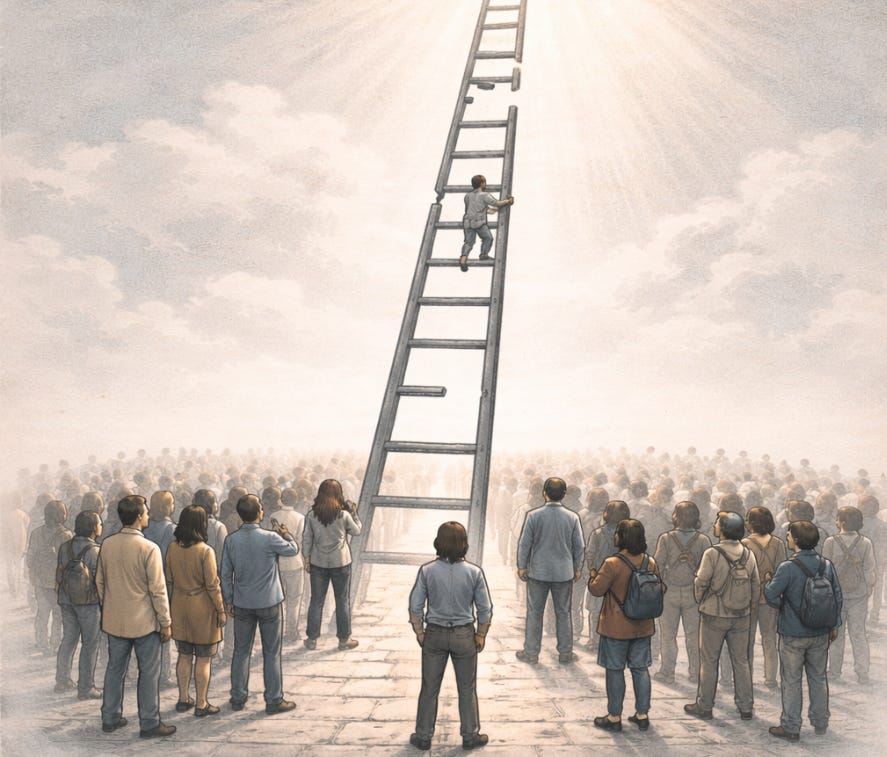
In the first part of this series, I described human potential as seven connected parts. If those parts shape who we can become, then a simple question follows: why do so many gaps remain?
We talk about potential constantly, in education, in companies, and in leadership books. Yet when you look closely, it is a potential most people are never really given the chance to reach.
This is not because people lack effort. It is because the systems around us were never designed to grow all parts of a human being at the same time.
The Systems We Built
Most of our institutions were designed for a different world.
Education systems were built to produce workers for industrial economies. Organisations were designed to maximise efficiency and output. Economic systems reward measurable results.
None of these systems were designed to develop the full range of human capability. They were built to specialise it. And specialisation, by its nature, always leaves gaps.
What Gets Measured Gets Grown
Over time, certain abilities became easier to measure. Grades, productivity, revenue, and performance metrics all provide clear signals that institutions can track and optimise.
When something can be measured, it quickly becomes a target. And when it becomes a target, systems begin to organise themselves around improving it.
The result is predictable. The measurable parts of human capability expand, while the harder-to-measure parts receive less attention. Judgment, self-understanding, relationships, and wisdom rarely appear on dashboards, so they are rarely prioritised.
The Cost of Growing One Part Too Far
When one part of potential grows faster than the others, imbalance appears.
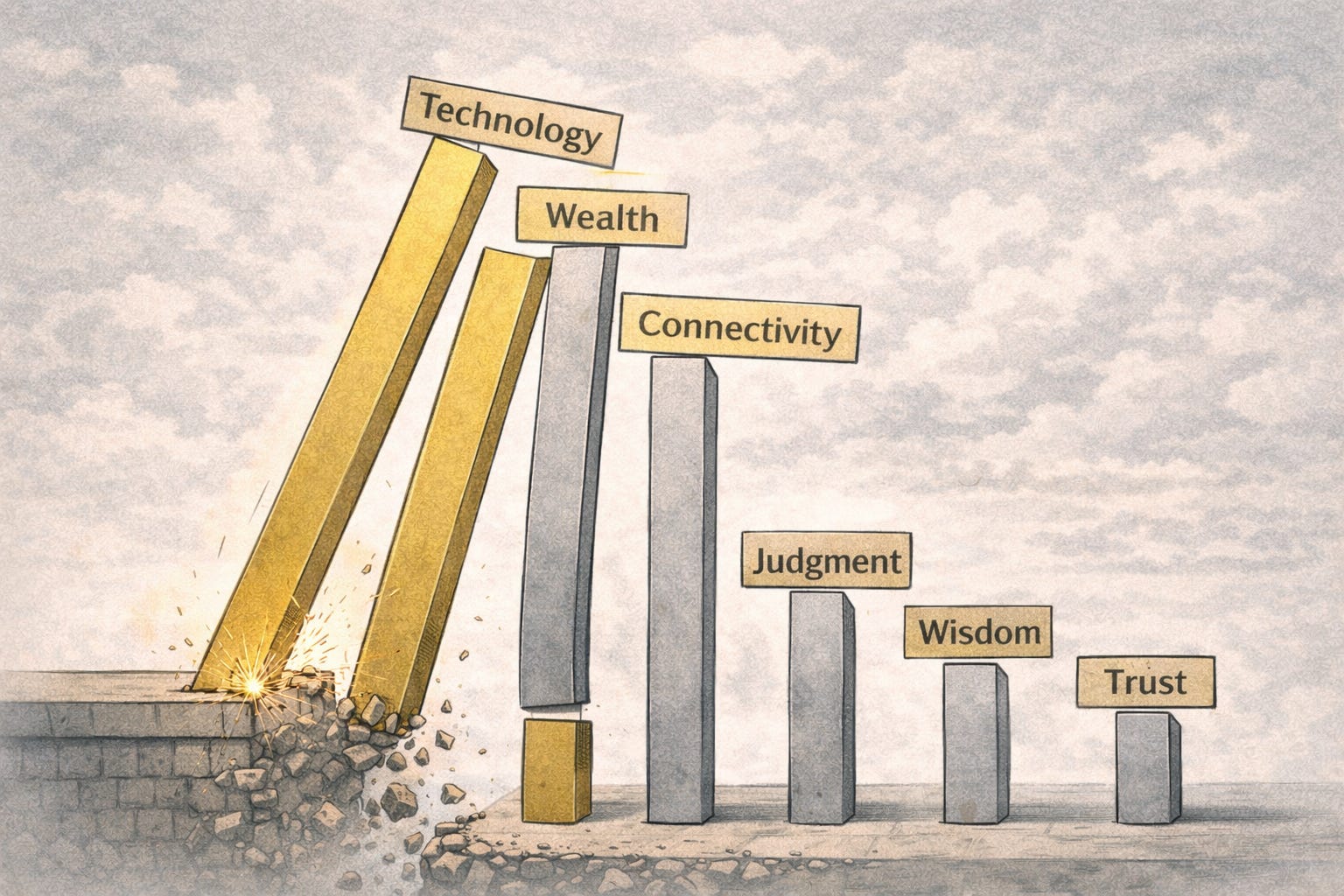
Technology advances faster than judgment. Wealth grows faster than security. Connectivity grows faster than trust.
None of these developments are inherently negative. Progress in one area often brings enormous benefits.
But without balance, progress in one area can quietly create weakness in another. This is how gaps form, not suddenly, but gradually, as attention and effort concentrate in only a few areas of human development
Why We Only Notice the Gaps Later
Most people encounter these gaps later in life.
They appear when work demands adaptability, when health requires attention, when relationships require emotional maturity, or when financial decisions carry real consequences.
These abilities matter deeply, yet many people are left to learn them through experience rather than guidance. Not because they are unimportant, but because they were never central to the systems that shaped us.
The Learning That Stops Too Early
For most people, structured learning ends in early adulthood.
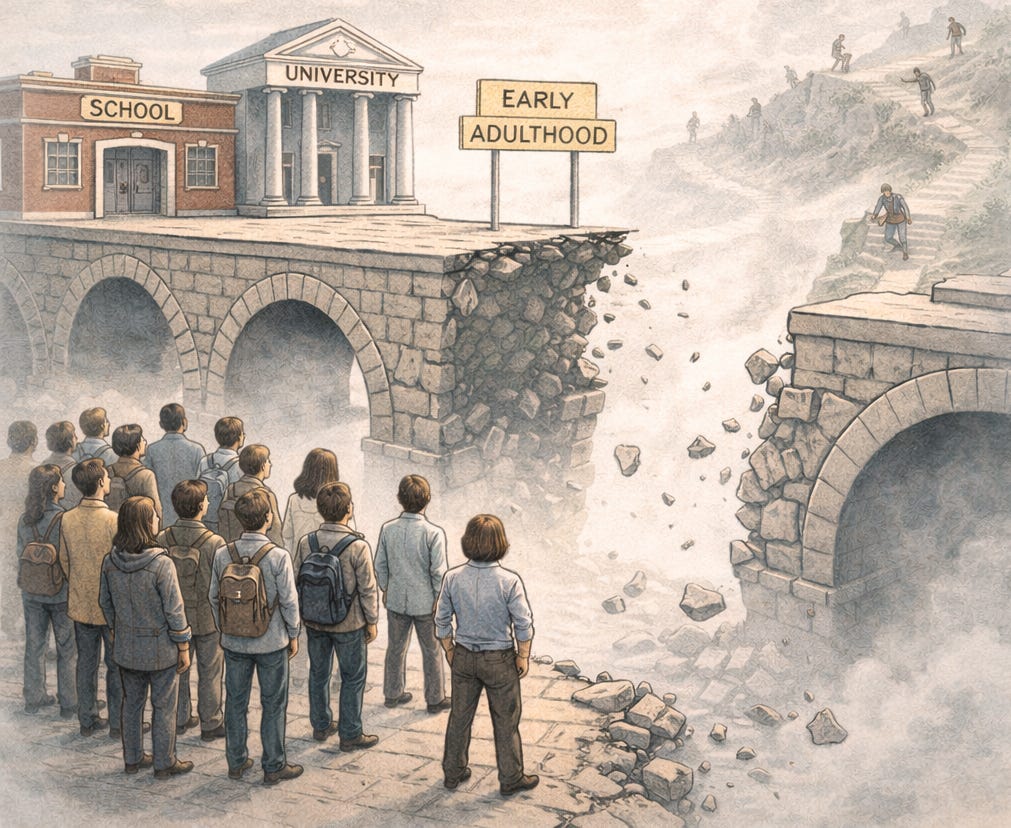
School teaches knowledge. University teaches specialisation. After that, learning becomes optional.
Yet many of the abilities that shape life, judgment, relationships, financial decision-making, health, and adaptability develop over decades, not within classrooms.
Despite this, we rarely design systems that help people continue developing these capabilities. Instead, people improvise through experience, mistakes, and sometimes crisis.
Learning continues, but without structure. And without structure, the gaps widen.
The Real Impact: Our Ability to Adapt
The real consequence of these gaps is not simply imbalance. It is reduced adaptability.
The modern world changes faster than any generation before us has experienced. Technology evolves, industries transform, and knowledge expands rapidly.
Adaptability is no longer optional. Yet adaptability depends on balance across multiple parts of human capability.
When those parts develop unevenly, responding to change becomes harder. This is not because people lack intelligence, but because they were never taught how to grow as a whole.
The Hidden Cost: How We Make Decisions
When adaptability weakens, something else follows: our decision-making suffers.
We see this in everyday life, in organisations, and in leadership. When decisions go wrong, we often blame the individuals making them, whether corporate leaders or national governments.
But judgment is not something people suddenly acquire when they reach positions of power. If we never learn to think deeply, reflect on consequences, or continue learning beyond the classroom, then decisions are often made in the moment, shaped by pressure, habit, or incomplete understanding.
Good decisions require more than information. They require judgment, and judgment is something that must be developed over time.
Where This Leads
Human potential is often described as something individuals must unlock. But potential does not develop in isolation.
It grows within the systems that educate us, the organisations we work within, and the structures that shape our lives.
If those systems develop only certain parts of human capability, the rest inevitably fall behind.
The real question is no longer whether people have potential. It is whether we are building systems that help people grow as whole human beings.
Next in the Series
If the gaps in human potential are structural, the next question becomes unavoidable.
What would it take to build a world where all parts of human potential can grow together?
That is where we go in Part III.