
The Future We Build
Why Debate Still Matters in the Age of AI

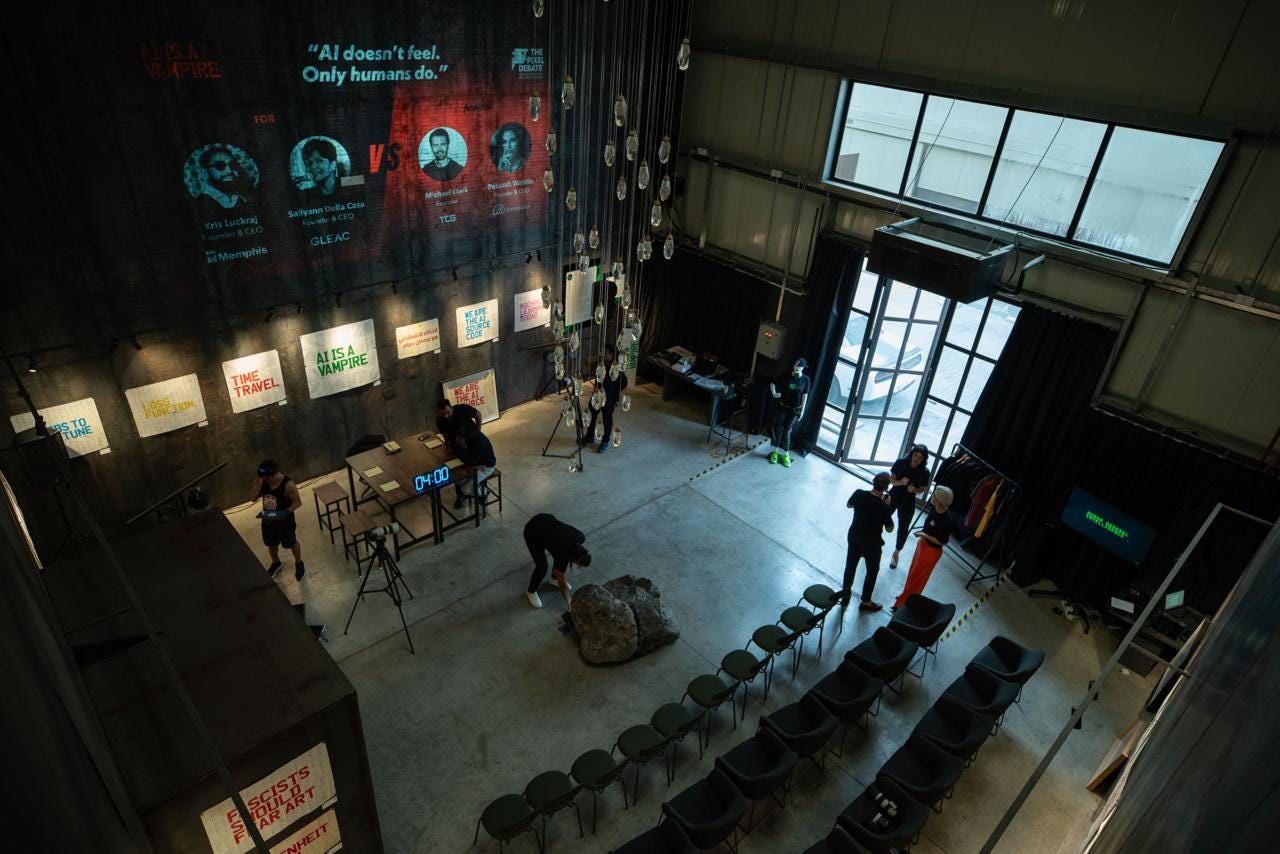
The lights were blinding. Cameras tracked our every move. A low hum of anticipation filled the room as the audience leaned forward in their seats, waiting for the first words to cut through the silence.
There I was, standing on stage, a question hanging in the air that felt bigger than me, bigger than the night itself: Humanity versus AI.
Debates are funny things. They’re part performance, part test of nerves, but underneath it all, they’re one of the oldest and purest ways we humans make sense of the world. The Greeks knew this. The Romans carried it forward. Enlightenment thinkers sharpened revolutions on its edge. Debate is where ideas are tested, stretched, and either broken or proven.
And as the motion was read aloud, I was reminded of something: debate is uniquely human. A machine can generate responses, but it doesn’t wrestle with meaning. It doesn’t feel the tension of being wrong or the exhilaration of persuading a room. That dance of curiosity, logic, empathy, and courage , that’s ours. But sadly, it’s becoming a dying art.
The Power of Debate
A good debate isn’t about shouting louder or winning points. It’s about friction, the healthy kind. You put two ideas against each other and see which one cracks. Or sometimes, you discover a third way that neither side saw coming.
“Debate is not the end of understanding, but the beginning of wisdom.”
— Michael Clark
That’s why I think debate is more important than ever. In a world overflowing with information, debate teaches us to slow down, question, listen, and refine. These aren’t just academic skills; they’re survival skills for our future.
A Lost Art?
Here’s the problem: debate has been vanishing.
Long before AI arrived, we were already losing the ability to wrestle with complexity. Schools cut back on formal debate and rhetoric programs. Public discourse shifted toward soundbites, headlines, and talking points. Social media rewarded certainty over curiosity, outrage over nuance.
Teachers feel it already: according to a Cambridge English survey, 85% of teachers globally feel their students don’t have the critical thinking skills they need when arriving at university. Cambridge University Press & Assessment
Curiosity too is slipping. In a vast PISA-based survey of 690,000 fifteen-year-olds across 81 countries, students who reported high levels of curiosity outperformed others by 81 points in global math tests. Perseverance (sticking with hard tasks) added another 61 points of advantage. The Australian
We see gap after gap: adults who say they value critical thinking often admit they don’t practice it, relying on what they know, avoiding complexity.
The result? We started seeing the world in binaries. Right or wrong, us or them, win or lose. Debate, at its best, isn’t binary, it’s discovery. It’s about holding tension, asking better questions, and sometimes even changing your mind.
If societies lose the art of debate, they lose something deeper. The capacity to adapt their values, rethink their views, and evolve together. And that loss is far more dangerous than any algorithm.
Humanity vs. AI
And then came the motion on stage: AI doesn’t feel, humans do..
It’s tempting to frame this as a fight. Man against machine. Winner takes all. That narrative is dramatic, but it’s also false. The real story isn’t about rivalry; it’s about partnership.
When you put together what we both bring, you get something neither could achieve alone. That’s why I’ve spent years reframing the way we look at AI, not as a threat, but as a partner. I call it Collaborative Intelligence.
Collaborative Intelligence
Collaborative Intelligence is a simple but profound idea, one where humans and machines work side by side to unlock human potential. Not replacing, but augmenting. Not automating us out, but drawing us forward.
And here’s the irony, debate itself is the perfect metaphor. Debate is messy, uncomfortable, and often frustrating. But it’s in that tension where breakthroughs happen. If we can learn to debate with each other, maybe we can also learn to debate with AI, questioning, pushing, refining, so together we arrive at better answers.
Learning to Debate Again
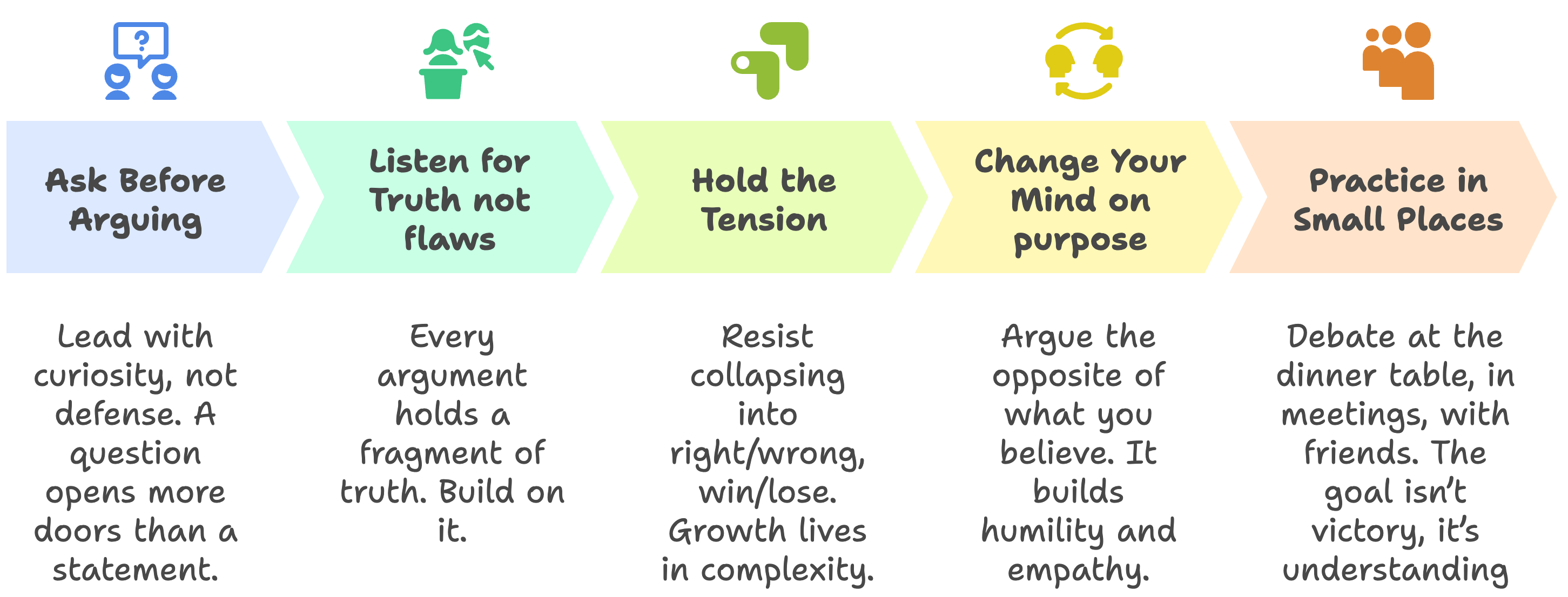
This brings us full circle back to debating, If debate is the metaphor and the training ground, then we need to practice it again. Not as performance, but as discipline. Not to win, but to understand.
Here are fives areas to consider:
The Future We Build
What I learned from this debate is that the act of debating matters as much as the topic itself. It forces us to hold on to what makes us human while also practicing the very skills we’ll need to partner with machines.
The future we build won’t be written by algorithms alone, nor by human will in isolation. It will be shaped in dialogue, in how well we argue, adapt, and ultimately, collaborate.
And maybe that’s the real motion we should all be debating: not Humanity versus AI, but Humanity with AI.
Because in the end, the question is not whether machines can outthink us, but whether we can still out feel ourselves, whether we will remember that wisdom lives not in certainty, but in our willingness to listen, to question, and to change.