
Your Business Doesn't Need a Data Strategy. Or an AI Strategy
It Needs One Strategy

Most organisations have a data strategy. A document, usually well-designed, occasionally well-presented, almost always well-intentioned. It talks about data as an asset. It references governance, quality, literacy. It has a roadmap with phases and owners and a go-live date.
Ask the CEO how it connects to revenue this year. Watch the pause.
That pause is the problem.
Data strategies have become the corporate equivalent of a gym membership something you acquire to signal intent, rarely the thing that actually changes your shape. They get built, presented, filed, and quietly forgotten while the business carries on making decisions the same way it always did.
Then we did it again with AI
Before the data strategy gathered dust, we started building AI strategies alongside it.
Same structure. Same slide deck. Same quarterly review. Different technology, identical outcome.
The moment you give AI its own strategy, it becomes a project. A workshop. A deliverable. Something you report on rather than something that changes how you compete. It gets its own sponsor, its own timeline, its own definition of success all carefully separated from the outcomes that actually matter to the business.
We spent a decade pulling data out of the business and handing it to a function. We are now making the same mistake with AI faster, louder, and with considerably more budget.
Data and AI still report to IT. And that tells you everything.
In most organisations, data and AI sit in technology. Sometimes they graduate to a governance committee. Occasionally they get a Chief Data Officer with a dotted line to the CFO and a mandate that stops at the edge of the business units.
What they rarely have is a seat at the table where the business strategy is actually made.
Think about what that means. The assets that determine whether you know your customers, whether you can price competitively, whether you can operate efficiently, whether you can see what is coming before your competitors do those assets are being treated as infrastructure. As tools. As something IT manages and governance signs off on once a quarter.
If data and AI are truly critical to how your business competes, the fact that they have no direct voice in the boardroom is not a technology problem. It is a strategic blind spot and it explains everything. Why the data strategy sits in a drawer. Why the AI programme is a series of pilots that never scale. Why the organisation keeps hiring for the roles without ever changing the structures that make those roles ineffective.
There is only one strategy
The businesses getting this right are not running data strategies and AI strategies in parallel with the business strategy. They have one strategy the business strategy and they ask a single, disciplined question at every point in it: where does data or AI move the needle here?

They are looking hard at their biggest friction points, in operations, in customer experience, in decision-making and asking whether AI changes the equation. Often it does. Significantly. But they start with the problem, not the technology. They sit with the business, find where value is being lost or left on the table, and ask what it would take to change it.
That is a different conversation. It is harder, slower, and less comfortable than an AI strategy session. It requires leaders who are willing to say the business is not working well enough in specific places and mean it.
What every business actually needs is a business strategy with data and AI woven into how that strategy gets executed. The moment you separate them, AI becomes a workstream to manage rather than a force multiplier on what you are already trying to achieve.
What that actually looks like
It looks like a leadership team that can answer four questions without opening a slide deck.
Where are the decisions in this business that are too slow, too costly, or too inconsistent and what changes if we get them right?
Where does data already exist that could sharpen those decisions, and what is stopping us from using it today?
Where can AI accelerate the answer, not as a separate initiative, but as the engine underneath work we are already doing?
Who owns the outcome, not the technology, not the roadmap, the outcome?
If you cannot answer these, you do not have an AI strategy problem. You have an alignment problem. And no amount of strategy documents will fix that.
The crowd and the quiet room

Picture two rooms. One is packed, energised, loud, full of people with slides and opinions . The sign on the door says AI Strategy Working Session.
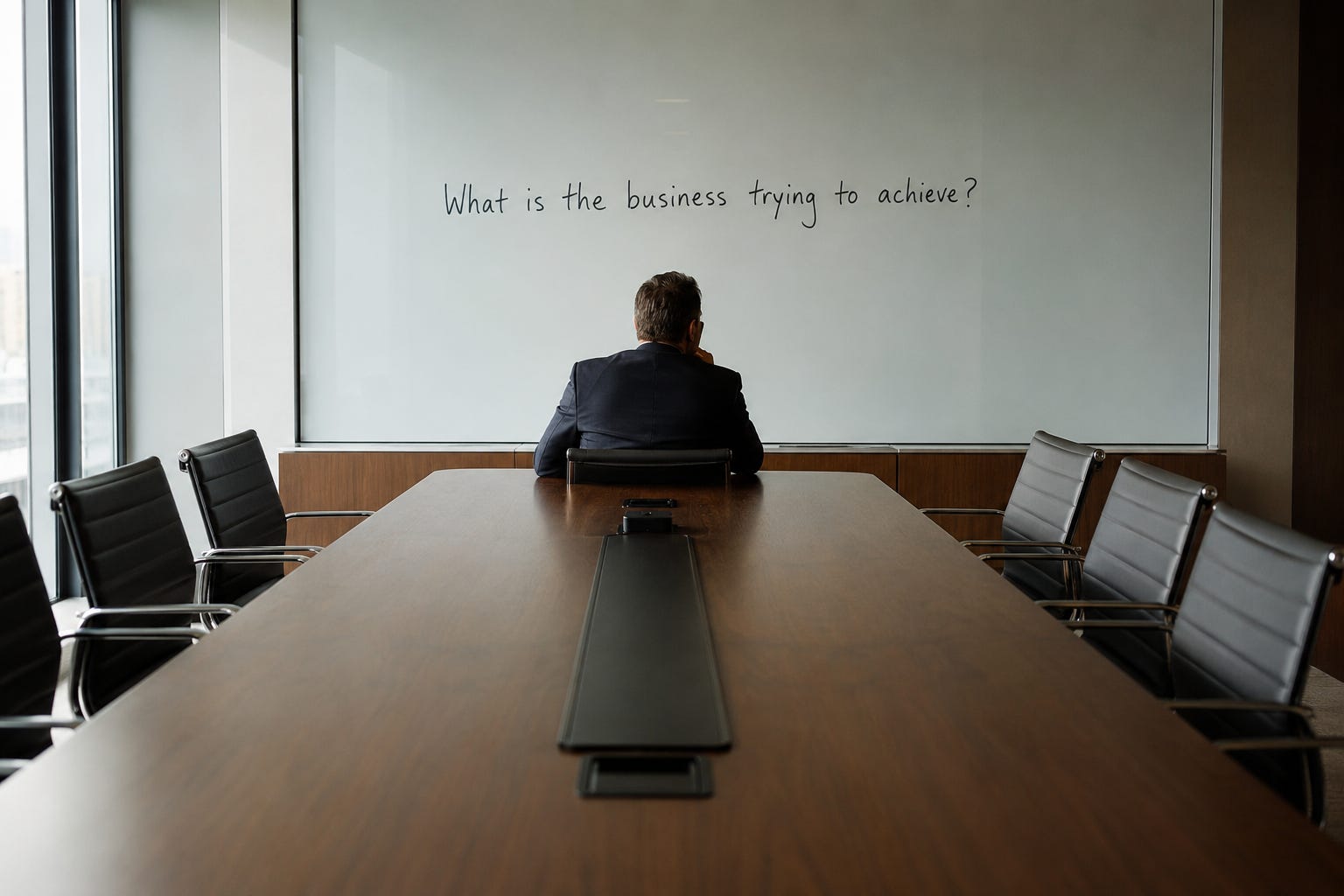
The other has the right people, a whiteboard, and one question written on it: what problem are we solving?
The hard part is not building the AI strategy. The hard part is convincing the crowd to walk into the other room, not for another strategy, but for honest problem definition and real alignment to what the business is actually trying to achieve.
And for that, you do not need an AI strategy.
You need the courage to ask better questions, the discipline to connect every technology decision back to a business outcome, and leadership that treats data and AI as how the strategy gets executed ,not as something that runs alongside it.
A note on the executives being hired for this
The leaders who will define the next decade are not the ones who built the best data strategy or launched the most impressive AI programme.
They are the ones who refused to let data and AI become somebody else’s problem. Who sat in the room where the business strategy was made and ensured that every meaningful decision had the right information behind it. Who treated technology not as a function to manage but as the operating model of the business itself.
That is a different profile from what most organisations are hiring for. It is an operator who understands the technology deeply enough to see where it changes the equation not a technologist who has learned to present to the board.
The gap between those two things is wider than most organisations realise. And it is costing them more than any failed data strategy ever did.
The stress test
Most businesses do not have a data problem or an AI problem. They have a clarity problem and a courage problem.
So here is the question worth putting to every leadership team. Not as a thought experiment, but as a genuine stress test.
If every piece of data dispersed across your business disappeared tomorrow ,every customer record, every transaction, every operational signal and every AI capability you have built vanished with it, what would you have left? Could you find your customers? Could you run your operations? Could you make a single confident decision about where the business goes next?
For most businesses, the honest answer is no.
The only question that matters
And yet we still treat these assets as tools that belong to technology, governed by committees, reported on quarterly, kept at a careful distance from the strategy they are supposed to serve.
If data and AI are that critical to your existence, they deserve to be at the centre of the only strategy that matters.
The most important question is not what your AI strategy is.
It is why it took this long to ask.
Michael Clark works with boards and leadership teams across the GCC on strategy, data, and AI